 The Daily
 Home›All Topics›Maca Root
Maca root benefits: what the research shows (and doesn't)
Maca gets marketed as a natural testosterone booster. The research says something more specific and, honestly, more interesting — a modest libido effect that has nothing to do with testosterone at all.
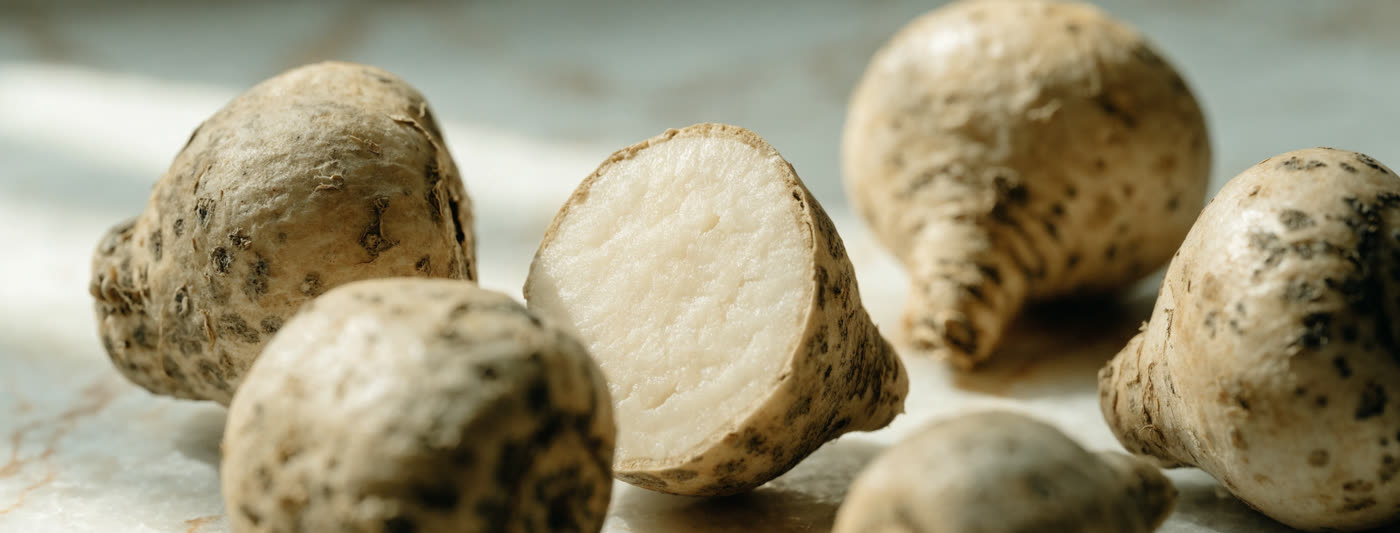
The short version
- Maca does not raise testosterone. This is a well-replicated finding across multiple RCTs, not an unproven gap — worth correcting rather than repeating the marketing claim.
- The real, modest finding is a libido effect — small trials show improved sexual desire, through a mechanism that isn't hormonal and isn't fully understood.
- Fertility claims are weak. The most rigorous recent meta-analysis found no significant effect on sperm concentration.
- It's a cruciferous plant — worth a conversation with a doctor if you have a thyroid condition.
The testosterone myth, corrected
A lot of maca marketing implies it works like a testosterone booster. The clinical research says the opposite, clearly enough that it isn't really a debate: a 12-week randomized trial in 57 healthy men found maca significantly improved self-reported sexual desire — and the paper's own title states the effect was independent of, and unrelated to, any change in serum testosterone or estradiol1. A separate pilot RCT measuring hormones directly found no significant change in testosterone, LH, FSH, prolactin, or thyroid hormones after 12 weeks of supplementation2. If a product or page tells you maca raises testosterone, that claim isn't supported by the trials that have actually looked for it.
What maca actually does, based on real trials
The best summary of the sexual-function evidence is a 2010 systematic review of four randomized trials3. Two of the four showed a positive effect on sexual desire or dysfunction; results were mixed in the other two. The review's own conclusion was that the evidence is too limited — in trial number, sample size, and methodological quality — to draw firm conclusions. That's the honest state of the science: promising, not proven.
A separate 12-week trial in 50 men with mild erectile dysfunction found a small but statistically significant improvement in erectile function scores and subjective well-being versus placebo, again with no change in testosterone between groups4. The effect size in these trials is modest, not transformative — this isn't a supplement anyone should expect a dramatic result from.
Fertility and sperm quality: the weakest claim
This is where the evidence is thinnest, and where the most rigorous recent research is least supportive. A 2022 systematic review and meta-analysis of five randomized trials found no significant effect on sperm concentration versus placebo, with mixed and inconsistent results on other semen parameters across the pooled trials5. If a page is selling maca specifically as a fertility aid, that claim runs ahead of what the best current evidence supports.
If the effect isn't hormonal, what is it?
Honestly: nobody knows for certain. No human trial has confirmed a specific mechanism for maca's effect on sexual desire. Some preclinical research points toward maca's alkaloids (macamides) acting on mood-related pathways rather than hormones, but that's a hypothesis, not an established finding. The correct way to describe this is "the mechanism isn't well understood and doesn't appear to be hormonal" — not to name a specific pathway as proven, which is more certainty than the research actually supports.
A safety note worth knowing
Maca is a member of the Brassicaceae family — related to broccoli and cabbage — and contains glucosinolates, compounds that can affect thyroid function at high enough intake (goitrogens). Traditional preparation involves cooking, which reduces this; most commercial "gelatinized" maca is processed similarly. One small pilot RCT measured thyroid hormones directly at a modest dose (1.75g/day, 12 weeks) and found no significant change2 — but that's one short, small study, not a dedicated thyroid-safety trial. Anyone with an existing thyroid condition, or on thyroid medication, should talk to a doctor before using maca regularly rather than assume it's automatically fine.
The label checklist
One page on reading a men's supplement label properly: what a "proprietary blend" is hiding, which ingredients are doing real work, and the three questions worth asking before you spend anything. Free, and there's nothing to sign up for.
Open the checklistThe bottom line
Maca root does not raise testosterone — that's settled, not a gap in the research. What it may modestly support, based on a handful of small but real randomized trials, is sexual desire, through a mechanism that isn't hormonal and isn't fully understood. Fertility claims aren't well supported by the current evidence. If you have a thyroid condition, talk to a doctor before regular use.
Sources
- Gonzales GF, et al. "Effect of Lepidium meyenii (Maca) on sexual desire and its absent relationship with serum testosterone levels in adult healthy men." Andrologia, 2002.RCT, 57 men, 12 weeks. Desire improved; testosterone/estradiol unchanged.
- Melnikovova I, et al. "Effect of Lepidium meyenii on Semen Parameters and Serum Hormone Levels: A Pilot Study." Evid Based Complement Alternat Med, 2015.RCT, 20 healthy men, 12 weeks. No significant change in testosterone or thyroid hormones.
- Shin BC, et al. "Maca (L. meyenii) for improving sexual function: a systematic review." BMC Complement Altern Med, 2010.Systematic review, 4 RCTs. Authors concluded evidence is too limited for firm conclusions.
- Zenico T, et al. "Subjective effects of Lepidium meyenii (Maca) in patients with mild erectile dysfunction." Andrologia, 2009.RCT, 50 men, 12 weeks. Small but significant improvement; testosterone unchanged.
- Lee HW, et al. "Maca on semen quality parameters: A systematic review and meta-analysis." Front Pharmacol, 2022.Meta-analysis, 5 RCTs. No significant effect on sperm concentration.
This article is general information, not medical advice, and does not replace a consultation with a qualified healthcare professional. Dietary supplements are not intended to diagnose, treat, cure or prevent any disease.